
Native American Mural Art and Native American Heritage Month
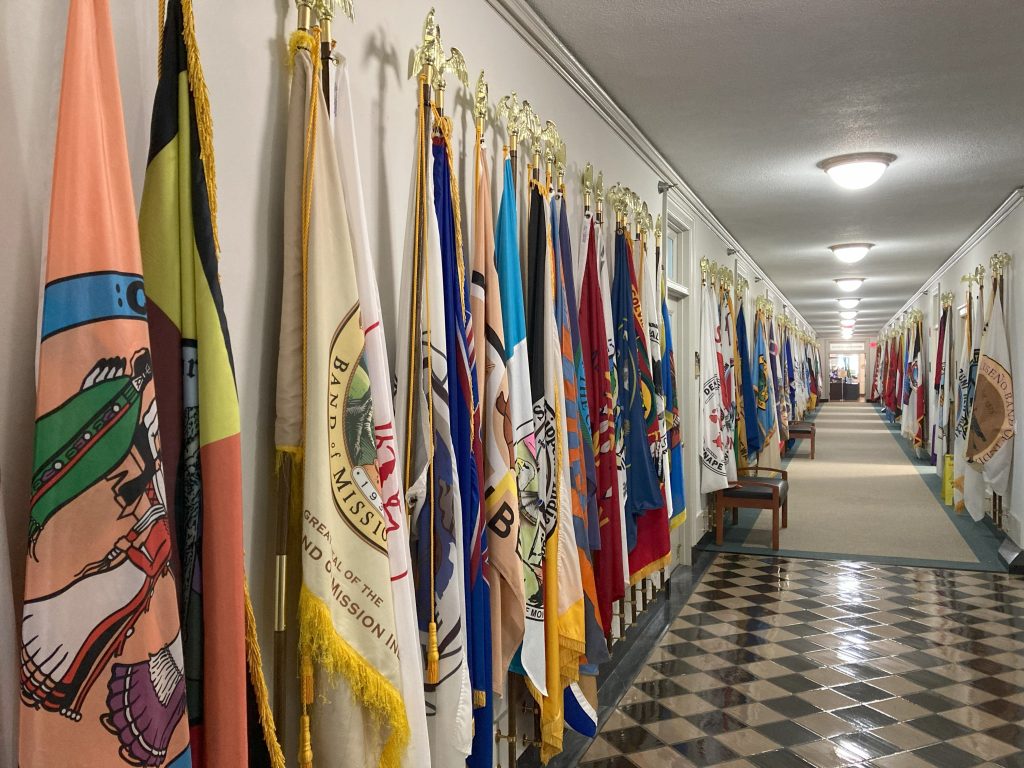
By Anastasia Walhovd, Preservation Archaeologist and Save History Staff Member
Save History is a collaboration of archaeologists, law enforcement, and the Bureau of Indian Affairs to end archaeological resource crime on Tribal lands. This work brings our staff to Tribal lands across the United States, and recently we had the rare pleasure of visiting Washington D.C. Our nation’s capital can feel like a world away from what many think of as Indian Country, but the truth is you can find Indigenous representation if you know where to look. For example, the image above is a shot of the Hall of Flags in the US Department of the Interior Building in Washington D.C. which contains flags from federally recognized Tribes across the United States.
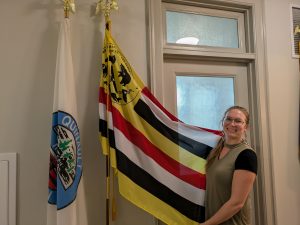
Figure 2. A. Walhovd excited to see her Tribe’s flag, Red Cliff Band of Lake Superior Chippewa, in the Hall of Flags, Bureau of Indian Affairs, US Department of the Interior, Washington D.C. Image by K. Schollmeyer.
In this post, Save History wants to highlight some of the art and artists encountered during this trip not only to showcase the diversity and beauty of this art, but also to highlight different ways that Native peoples have been championing and protecting their traditions, ways of life, and heritage. We at Save History do the work of eliminating archaeological resource crime in the interest of protecting cultural heritage. In order to remember why we fight so hard for it, we need to periodically take a step back and just appreciate what it is we are fighting for.
One of my biggest pet peeves is hearing people say that Native Americans are all gone—considering I have a family filled with Tribal members from two different federally recognized Tribes and I have friends from Tribes all across the United States (Mexico and Canada too!), I know that’s just not true. But this is the sort of rhetoric and stereotype that keeps the average American from recognizing Native American archaeological sites as places that are valued and part of modern Native American heritage. It’s a screen behind which one can ignore the victims of archaeological resource crime. In the spirit of recognizing Native American cultural heritage and dispelling hurtful assumptions, let’s check out some of the murals located on the top floor of the US Department of the Interior, Main Interior Building.
My colleagues and I were stunned at the Native American murals we found during our tour of the Main Interior Building with Bureau of Indian Affairs Curator Justin Giles. Each of these Native American artists was born during the height of the boarding school era—schools that incorporated assimilation practices and discouraged Native languages and culture. Each of these muralists’ lives were touched by this reality in some way. Despite this, each went on to live lives filled with Native art. Check out the murals and the artists’ bios below.
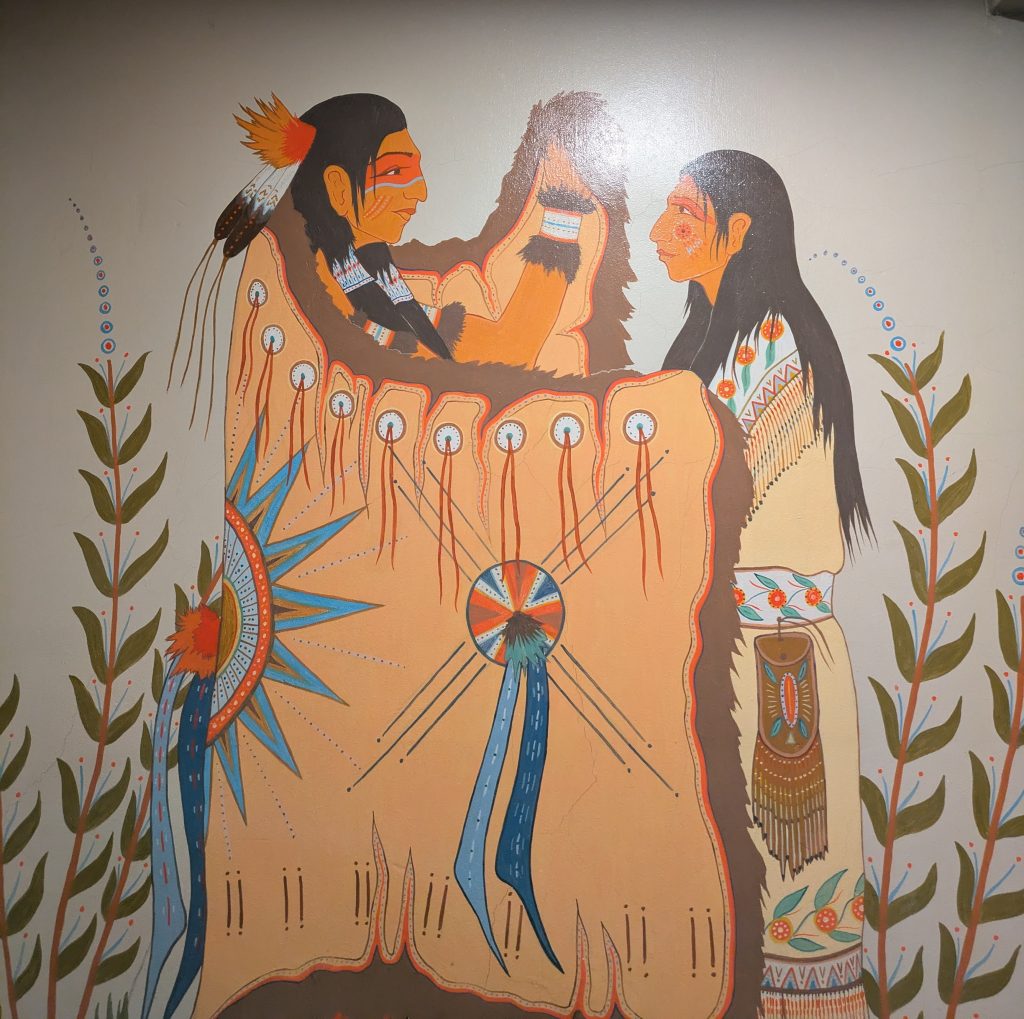
Figure 3. Courting, Potawotamie Life, Woodrow Wilson Crumbo. Image by A. Walhovd.

Figure 4. Buffalo Hunt, Potawotamie Life, Woodrow Wilson Crumbo. Image by A. Walhovd.
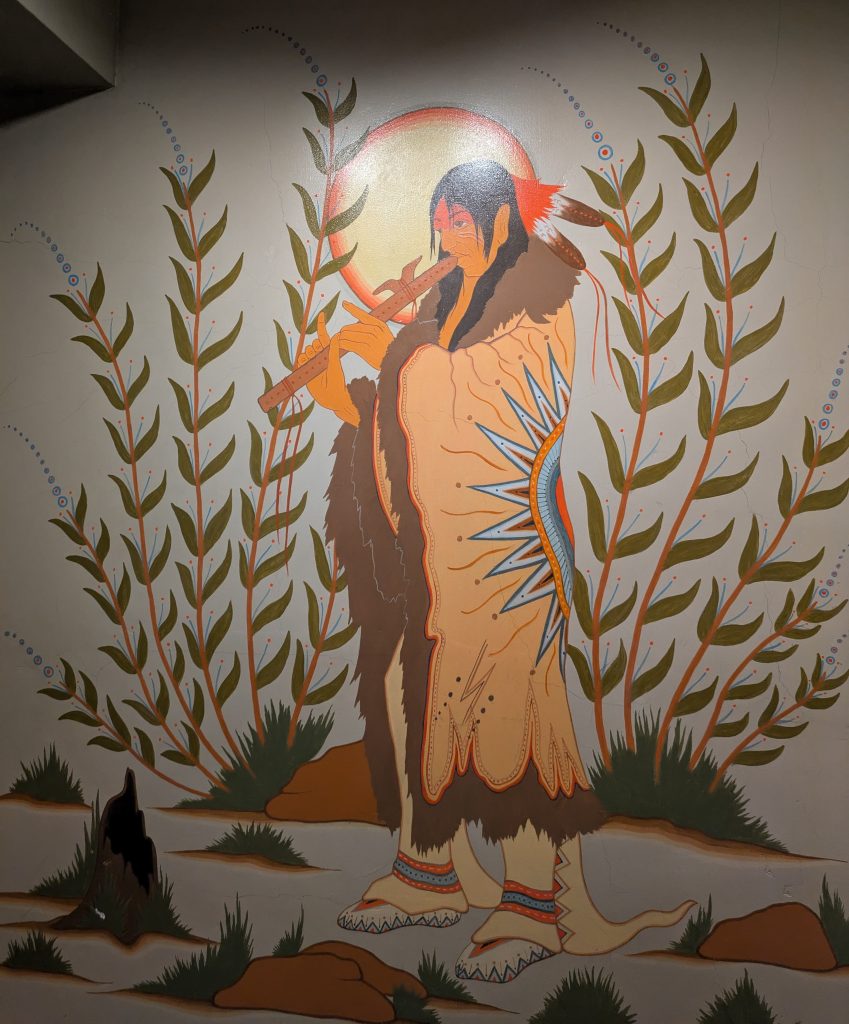
Figure 5. Flute Player, Potawotamie Life, Woodrow Wilson Crumbo. Image by A. Walhovd.
Figures 3-5 are selections from Potawotamie Life by Woodrow Wilson Crumbo
Woodrow Wilson Crumbo (1912 – 1989) was Potawatomi (Potawotamie). His murals can be found at Oklahoma University, the US Department of the Interior Building, and the US Post Office in Nowata, Oklahoma. The diversity of his artistic talent included ceremonial and traditional dancing, cedar wood flutist, watercolor painting, oil painting, sculpture, stained glass, silkscreen, and etching. Crumbo served as the Director of Indian Art at Bacone College, an artist-in-residence at the Gilcrease Institute of American History and Art, and the Assistant Director of the El Paso Museum of Art.
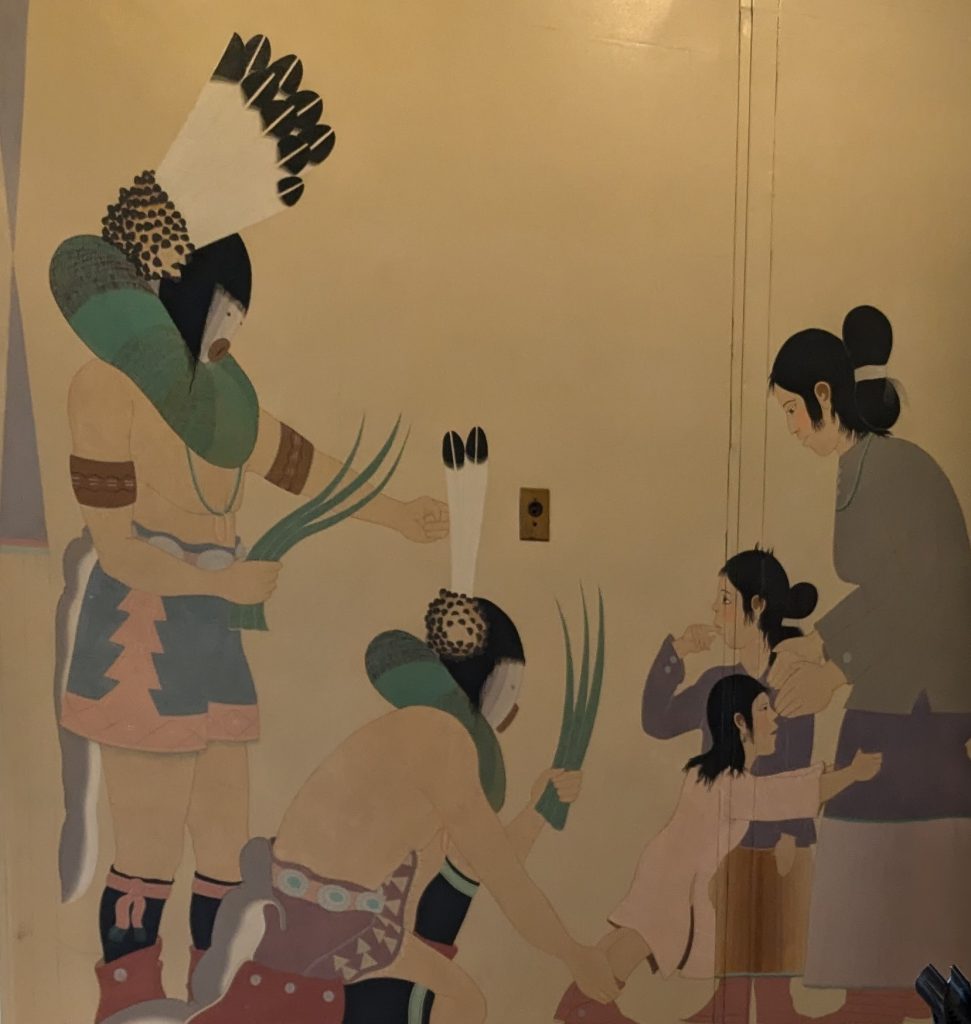
Figure 6. Initiation Ceremony, Navajo Scenes, Gerald Lloyd Nailor Toh Yah. Image by A. Walhovd.

Figure 7. Preparing Yarn for Weaving, Navajo Scenes, Gerald Lloyd Nailor Toh Yah. Image by A. Walhovd.
Figures 6-7 are selections from Navajo Scenes by Gerald Lloyd Nailor
Known by his Navajo Name, Toh Yah, Gerald Lloyd Nailor (1917-1952) was a member of the Navajo Nation. His murals can be found at the US Department of the Interior Building, Mesa Verde National Park, and Navajo Tribal Council in Window Rock, Arizona. His art has been exhibited in various institutions including the Museum of New Mexico, the Denver Art Museum, the Museum of Modern Art in New York, the Philbrook Art Center in Tulsa, Oklahoma, and the Inter-Tribal Indian Ceremonial in Gallup, New Mexico. He shared an art studio with fellow muralist Allen Houser in Santa Fe, New Mexico.
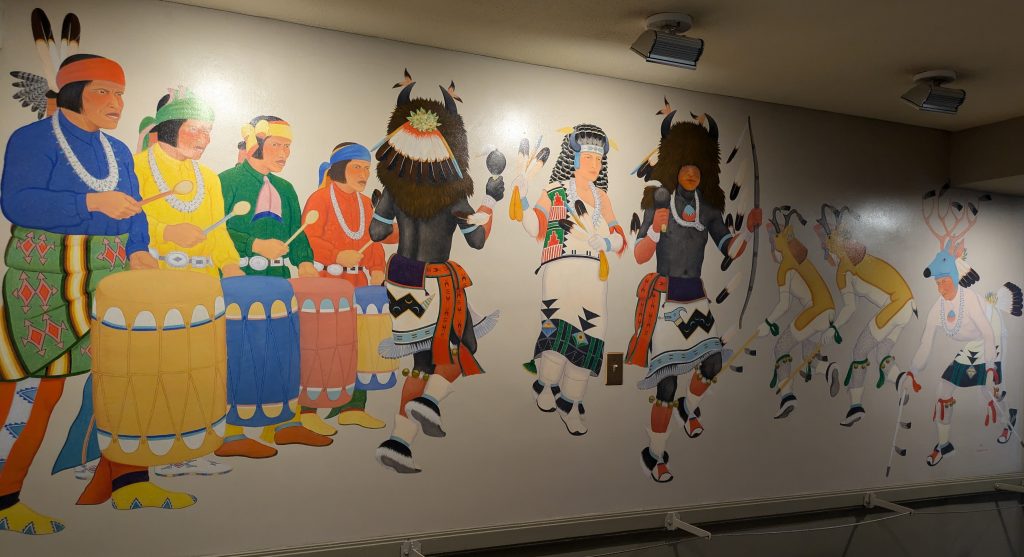
Figure 8. Buffalo Dance, Pueblo Life, Velina Shije Herrera Ma Pe Wi. Image by A. Walhovd.

Figure 9. Pueblo Girls Carrying Water, Pueblo Life, Velino Shije Herrera Ma Pe Wi. Image by A. Walhovd.

Figure 10. Women Making Pottery, Pueblo Life, Velino Shije Herrera Ma Pe Wi. Image by A. Walhovd.
Figures 8-10 are selections from Pueblo Life by Velino Shije Herrera
Velino Shije Herrera (1902-1973), also known as Ma Pe Wi, was born in Zia Pueblo. His murals can be found at the US Department of the Interior Building, the Kiva Museum of the Koshare Indians, the Boy Scouts of America in La Junta, Colorado, and the Albuquerque Indian School. His art has been exhibited at the Annual Indian Market in Santa Fe, New Mexico, the Exposition of Indian Tribal Art in New York City, the Heard Museum in Phoenix, Arizona, the Inter-Tribal Indian Ceremonial in Gallup, New Mexico, the Philbrook Art Center in Tulsa, Oklahoma, and the Southwest Museum in Los Angeles, California. He gave permission for the state of New Mexico to adapt the Zia sun symbol for use as the state logo, for which he was criticized by many in the Zia Pueblo community. He was awarded the Ordre des Palmes Académiques by the French government, an award given to distinguished academics and teacher for their service to universities, education, and science.

Figure 11. Singing Love Songs, Apache Scenes, Allan C. Houser Haozous. Image by K. Schollmeyer.
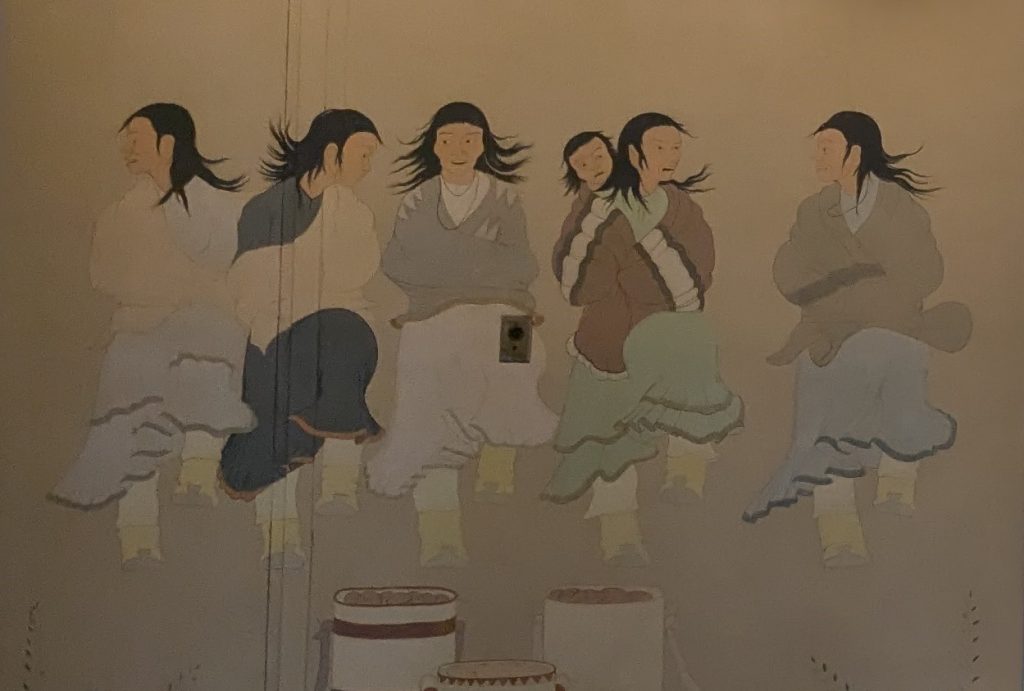
Figure 12. Apache Round Dance, Apache Scenes, Allan C. Houser Haozous. Image by A. Walhovd.
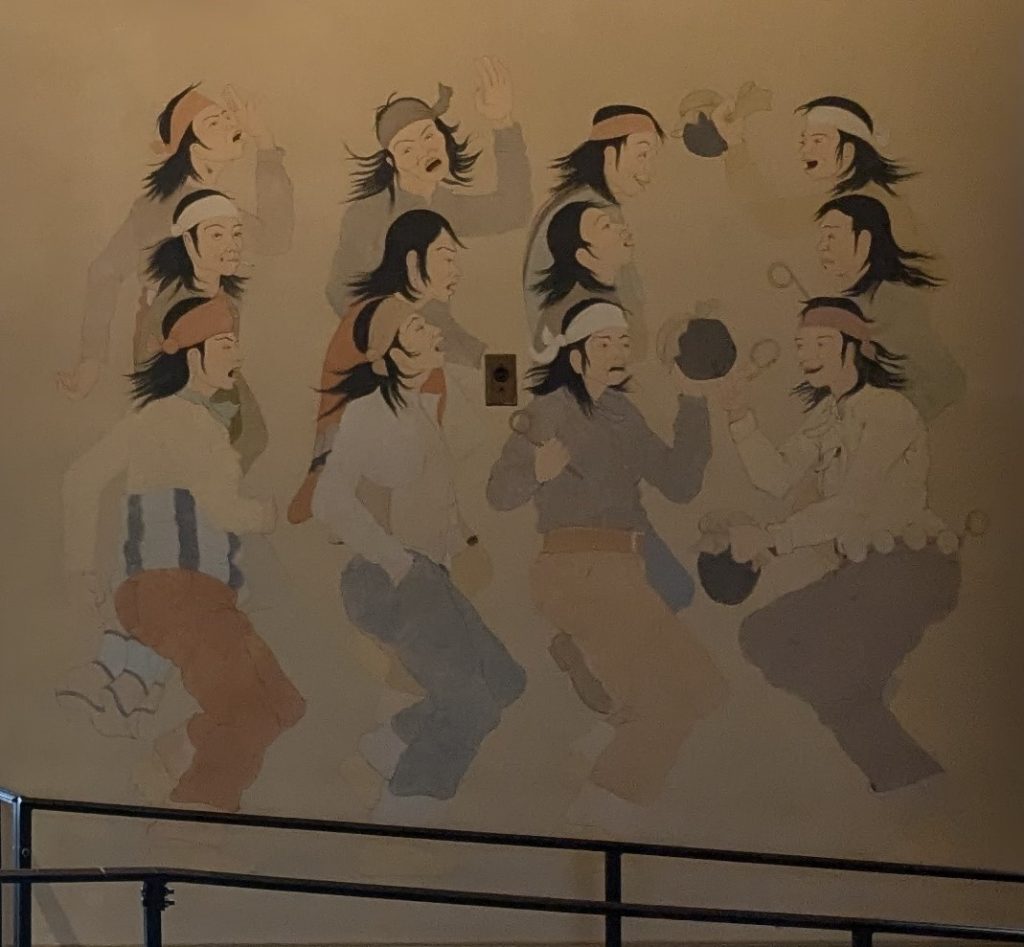
Figure 13. Sacred Fire Dance, Apache Scenes, Allan C. Houser Haozous. Image by A. Walhovd.
Figures 11-13 are selections from Apache Scenes by Allan Houser
Born Allan Capron Haozous, Allen Houser (1914-1994), was Chiricahua Apache. His name, Haozous, describes the sound of pulling plant roots from the ground in the Apache language. He was commissioned for murals in the US Department of the Interior Building, the Golden Gate Exposition in San Francisco, and the New York World’s Fair. Beyond murals, Allan’s artistic talents also included watercolor, drawing, wood and stone sculpture, and multiple musical instruments. He has dedicated art works to the United Nations, the National Portrait Gallery, and the Smithsonian Institute. He shared a studio with fellow muralist Gerald Lloyd Nailor in New Mexico. His mother was born in captivity at the Mount Vernon Barracks and later held prisoner in Fort Sill. His father was among the Apache imprisoned in St. Augustine and later Fort Sill. Allan was the first in his family to be born out of captivity after the Apache were granted their freedom in 1913.
We’ve highlighted Native American muralists in this blog post, but Native American heritage can be seen literally on the landscape. Want to learn more about how SaveHistory.org is working to protect Native American heritage and history? Read about it here: https://savehistory.org/why-save-history/
Sources
Houser, Allan
N.D. Biography. AllanHouser.com.
< Accessed October 2, 2024 https://allanhouser.com/the-man >
Look, David W. and Carole L. Perrault,
1986 The Interior Building: its architecture and its art. US Department of the Interior, National Park Services, Preservation Assistance Division, Preservation Case Studies.
<Accessed October 2, 2024 https://babel.hathitrust.org/cgi/pt?id=mdp.39015029850214&view=1up&seq=157 >
Smithsonian American Art Museum
2024 Allan Houser. Artist Profile.
< Accessed October 2, 2024 https://americanart.si.edu/artist/allan-houser-6734 >
2024 Velino Shije Herrera. Artist Profile.
< Accessed October 2, 2024 https://americanart.si.edu/artist/velino-shije-herrera-2187 >
2024 Woodrow Crumbo. Artist Profile.
< Accessed October 2, 2024 https://americanart.si.edu/artist/woodrow-crumbo-1059 >
US General Services Administration Fine Arts Collection
2024 Gerald Nailor. Artist Profile.
< Accessed October 2, 2024 https://art.gsa.gov/artists/2120/gerald-nailor/objects >