
Professional Perspectives from Anastasia Walhovd: Studying up on Archaeological Resource Crime
In 1979, the Archaeological Resources Protection Act (ARPA) was passed. The law’s intention is to protect archaeological sites on Federal and Tribal land. The people who steward and care for the land that these sites are on have the responsibility to uphold the law when they see ARPA violations. The Save History campaign educates the public about ARPA, but we also do trainings for those who directly record these crimes in the field—archaeologists, law enforcement officers, cultural resource managers, and Tribal Historic Preservation Officers. If you’d like to read a little bit more about what an ARPA training is, check out our previous blog post Archaeological Resource Crime in Montana: Training the Professionals. Three of our students from the most recent course in Billings, Montana—Bill Kurtz, Skylar Begay, and Anastasia Walhovd—graciously agreed to share a little about their experience and what about archaeology, ARPA, and archaeological resource crime that they wish the general public had a better grasp of. Check out Anastasia Walhovd’s interview below!
Tell me about yourself and your work.
My name is Anastasia Walhovd, and I am a Preservation Archaeologist with Archaeology Southwest. Specifically, I help run the Save History national education and outreach campaign to inform the public about archaeological resource crime on Tribal land. I just started with Archaeology Southwest in June 2024 so I am the newest member to this awesome team. I am an enrolled member of the Red Cliff Band of Lake Superior Chippewa which is a part of my identity that I am always aware of when I do this work as both an archaeologist and an Indigenous person.
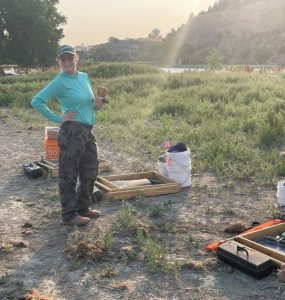
Archaeology Southwest Preservation Archaeologist Anastasia Walhovd helping to prepare the in-field ARPA Training Exercises in Billings, Montana.
Why were you interested in taking this course?
I have a certificate in Cultural Resource Management from New Mexico State University, so I had learned a lot about ARPA in a classroom setting. I also attended an online ARPA Damage Assessment training that Shannon Cowell and former Save History team member Ashleigh Thompson did in Fall 2023. But since joining the team, I hadn’t seen the full 40-hour training in action yet and learned in depth about the law enforcement perspective. So, while I was partly an instructor for the course to teach about the education and outreach campaign to the students, I was also definitely a student and learning along with the other professionals.
Have you worked on ARPA/archaeological resource crime cases before taking this course?
I have helped with the report writing aspect that comes after an archaeological resource crime has been documented in the field at the actual crime scene. I have reported a potential ARPA violation to the proper authorities once as a visitor on an archaeological site, but I haven’t had the opportunity yet to do a damage assessment in person.
What top 3 things from the class stuck with you the most?
This course has content that is for archaeologists and content that is for law enforcement. I think for me, as I am an archaeologist and not law enforcement, I really enjoyed hearing about these crimes from the perspectives from 1) our law enforcement representative Dusty Whiting and 2) our legal expert Randy Ream. Also, 3) learning about all the different tools law enforcement has to investigate these crimes was fascinating. It felt like learning about all the things they use on TV to solve crimes. The entire world of law enforcement is definitely more foreign to me as an archaeologist. Nearly ten years ago, I worked as a paralegal in Wisconsin so the intersection of the law and archaeology, to me, is a very interesting place to learn about.
What would you like to know more about regarding archaeological resource crime?
I would like to know more about case studies of ARPA civil cases, not just felonies and misdemeanors. I will get the opportunity to learn more about that at another training in 2025.
What about archaeology or archaeological resource crime do you wish the general public knew about?
Regarding archaeology, I wish the general public knew how much of it we have in the United States. The general public often thinks of most of the United States as empty beautiful landscape. It’s not! People have been living on nearly every inch of the United States for thousands of years. Regarding archaeological resource crime, I wish the general public knew how prevalent it is, how much damage it causes, and how to visit archaeological sites and appreciate archaeology safely and respectfully.
Want to hear more professional perspectives?
Check out perspectives from:
Bill Kurtz, Bureau of Indian Affairs Midwest Regional Archaeologist
-and-
Skylar Begay, Director of Tribal Collaboration in Advocacy and Outreach
Interested in learning from ARPA Legal Expert Randy Ream too?
Check out the blog posts he has written for SaveHistory.org!
A New Start? Understanding the Latest NAGPRA Regulations
How Often Are Heritage Resource Crimes Prosecuted in Arizona?