
Professional Perspectives from Bill Kurtz: Studying up on Archaeological Resource Crime
In 1979, the Archaeological Resources Protection Act (ARPA) was passed. The law’s intention is to protect archaeological sites on Federal and Tribal land. The people who steward and care for the land that these sites are on have the responsibility to uphold the law when they see ARPA violations. The Save History campaign educates the public about ARPA, but we also do trainings for those who directly record these crimes in the field—archaeologists, law enforcement officers, cultural resource managers, and Tribal Historic Preservation Officers. If you’d like to read a little bit more about what an ARPA training is, check out our previous blog post Archaeological Resource Crime in Montana: Training the Professionals. Three of our students from the most recent course in Billings, Montana—Bill Kurtz, Skylar Begay, and Anastasia Walhovd—graciously agreed to share a little about their experience and what about archaeology, ARPA, and archaeological resource crime that they wish the general public had a better grasp of. Check out Bill Kurtz’s interview below!
Tell me about yourself and your work.
I have been a BIA Midwest Regional Archaeologist since 2001. In this position I work with 36 Tribal Nations in Minnesota, Wisconsin, Michigan, and Iowa. Previous to my present position I was Standing Rock’s first Tribal Archaeologist from 1998-2001. Previous to that position I was Archaeologist for the US Forest Service in North Dakota and South Dakota on the Little Missouri and Grand River National Grasslands and the Black Hills National Forest from 1990-1998. Previous to that position I worked as an archaeologist for the South Dakota Archaeological Research Center from 1986-1990. In 1986 I finished my MA in Anthropology. While an undergraduate and graduate student I worked as an archaeologist for University of North Dakota, University of Iowa, Northern Illinois University, the Illinois State Museum, Fort Abraham Lincoln Foundation, and Foundation for Illinois Archaeology.
Why were you interested in taking this course?
I had previously taken the FLETC ARPA class with the USFS in 1991 and with Standing Rock in 1998. Also I have taken the BIA ARPA training in 2002 and Advanced ARPA training in 2003. However, I had not had ARPA training for 20 years, so I thought it would be a good time to take ARPA training again.
Have you worked on an ARPA crime case before?
I have worked on an ARPA case in 2000 at Standing Rock where we got two convictions, which was the case I [presented on as a guest speaker for the course.]
What top 3 things from the class struck you the most?
1) Teamwork is essential between law enforcement, archaeologists, and rest of the team.
2) ARPA cases can get very complicated.
3) ARPA convictions are not easy but can be accomplished.
What would you like to know more about regarding archaeological resource crime?
I like the ARPA case studies because it’s important to know how the ARPA violation happened, and what the results were. Most of cases we hear about are cases that end in convictions, but it would also be good to hear about cases that didn’t go well and what went wrong and why there was not any convictions. I would also like to hear more about ARPA crime prevention, how we can prevent ARPA crime from happening.
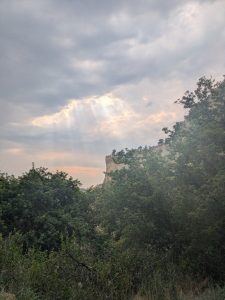
Image taken from Pictograph Cave outside of Billings, Montana. Credit: A. Walhovd.
What about archaeological resources crime do you wish the general public knew about?
I think it is important for the public to know everything possible about archaeological crime and how it disturbs and destroy sites and how the crimes are prosecuted so it will be a deterrent for the public to commit the crimes. The more information and education the public gets about archaeological crime the better.
Anything else you’d like to talk about regarding the training or archaeological resource crime?
The training was great and I really enjoyed it and learned a lot. One more idea I would like to see at the class would be to do a field trip during the class to learn about a site in the area of the training. Since the agenda is full this could be done in the evening. For example, a good site to visit near is Pictograph Cave, outside of Billings.
Want to hear more professional perspectives?
Check out perspectives from:
Skylar Begay, Director of Tribal Collaboration in Outreach and Advocacy
-and-
Anastasia Walhovd, Preservation Archaeologist.