
Professional Perspectives from Skylar Begay: Studying up on Archaeological Resource Crime

In 1979, the Archaeological Resources Protection Act (ARPA) was passed. The law’s intention is to protect archaeological sites on Federal and Tribal land. The people who steward and care for the land that these sites are on have the responsibility to uphold the law when they see ARPA violations. The Save History campaign educates the public about ARPA, but we also do trainings for those who directly record these crimes in the field—archaeologists, law enforcement officers, cultural resource managers, and Tribal Historic Preservation Officers. If you’d like to read a little bit more about what an ARPA training is, check out our previous blog post Archaeological Resource Crime in Montana: Training the Professionals. Three of our students from the most recent course in Billings, Montana—Bill Kurtz, Skylar Begay, and Anastasia Walhovd—graciously agreed to share a little about their experience and what about archaeology, ARPA, and archaeological resource crime that they wish the general public had a better grasp of. Check out Skylar Begay’s interview below!
Tell me about yourself and your work.
I am Director of Tribal Collaboration at Archaeology Southwest (ASW). That entails doing conservation based work for the organization such as Respect Great Bend, a campaign to create a National Monument here in Arizona. I coordinate staff in 13 other organizations, do advocacy work, talk to press, and coordinate events. I present to Tribal councils, Tribal Historic Preservation Officers (THPOs) and Cultural Resource Departments on this topic and on Save History as well. The other half of my job is helping ASW with our Tribal collaboration efforts. We are trying really hard to be more inclusive and include Tribes in more robust ways.
Why were you interested in taking this course?
A few reasons: I’m not an archaeologist. As someone working with ASW and not being an archaeologist, it’s different for me. But because I work with Save History and ASW, I want to be more informed about the intersection of archaeology and law enforcement. I want to be supportive of [fellow ASW staff] Shannon and Anastasia in this work. To do so it was necessary to show up and be a part of it. It was also a good excuse to get to know then new employee Anastasia, to check out Montana, and escape from Tucson for a bit.
More generally, the issue of looting and vandalizing and theft of cultural items is… important [doesn’t encompass what I want to say and] isn’t the right word… but it’s a huge issue for Indigenous Peoples. We’ve lost so much already and that material legacy that is left on the land by our ancestors is a really good way to reconnect to the things we’ve lost in the past. It’s important to be educated about this issue and understand well enough that we can make some sort of positive impact. Most of my involvement with Save History is about the branding, campaign, and communications. Respect Great Bend and its campaign has been a big part of what I have done. [To me, the biggest impact for a campaign like this is] about making enough noise, raising enough awareness to make people care. I needed to get a good foundation in order to better communicate to the public and make people care.
Have you worked on ARPA/archaeological resource crime cases before?
I’ve done some restoration work. There is an O’odham site here in Tucson called the Romero Site. It was looted a long time ago. We partnered with the Forest Service and the State to do some restoration work on it, and there were also folks from Gila River Indian Community and Tohono O’odham Nation. We did a mock damage assessment and learning how to process a looted hole, how to calculate the volume of the dirt that was removed, and how to put it back into the ground in a good way. At the same time, we also treated it as a mock crime scene with law enforcement there.
[Another site I worked on was up on the Navajo Reservation.] There is a Hopi petroglyph site that had been vandalized and spray painted. We worked with Gila River Indian Community and Ancestral Lands Conservation Corps and went out to the site, camped out for 5 days, and we did a bunch of experimenting with [the graffiti removal substance called] Elephant Snot. We applied it to the vandalized areas and used a portable power washer to wash it off.
What top 3 things from the class stuck with you the most?
1) I think the most frustrating aspect is the prosecution statistics. The fact that ARPA can very easily become a felony, but despite that it doesn’t really get the full extent of what the law says you can be penalized for like jail time and fines. I don’t know what that’s rooted in and why a judge wouldn’t want to prosecute to the full extent. That doesn’t make a lot of sense to me. I think it’s maybe a symptom of the greater problems and false assumptions that lot of Indigenous people face like: we are gone or that the items are old and it doesn’t matter or that it’s doesn’t affect us in real ways. I hope there can be a change on that.
2) The case laws that we went over and Randy Ream’s part as a former prosecutor and AUSA was really interesting. I hadn’t really experienced that side of the work or the program yet.
3) This training seemed like our most diverse in Tribes represented and representation between archaeologists and law enforcement. I really enjoyed that aspect of the class the most. You wouldn’t think that archaeologists and law enforcement would need to work together, but it’s cool to see that people care enough to show up for a 40-hour course and sit in a classroom for a week.
What would you like to know more regarding archaeological resource crime?
I think I’m curious about the everyday person who is not an archaeologist nor a law enforcement officer—how they perceive the issue or if they are even aware of the issue. If they are aware, I want to know what they think about it. How does it make them feel? Do they have a positive or a negative perception of the looting of antiquity? That’s something that is kind of hard to gauge. We can look at statistics, but maybe if we did some sort of survey that could be sent out by a polling company and get a large dataset and see how we might improve the messaging for Save History. The goal is to humanize the issue, and I believe you make people care by telling stories. Elevating Indigenous voices is a big part of the campaign and making people aware these aren’t victimless crimes.
What about archaeology do you wish the general public knew about?
I think that it’s a big part of Native culture, if we are talking about archaeology here in the US specifically. I think a lot of people don’t realize, take Phoenix for instance, however many millions of people live there. How many people know that the Gila River Indian Community is right there in the city? Do people know that Phoenix is built on one giant archaeological site from O’odham Ancestors? People might hear about it here and there or know a little here and there. I’d like people to know we are still here. We are still connected to archaeological sites, but we don’t call them that. These are where our ancestors lived. We have a lot of protocol in place and teachings in place about how to interact with a place like that—a site. I would like people to realize how much we still have connections to these places.
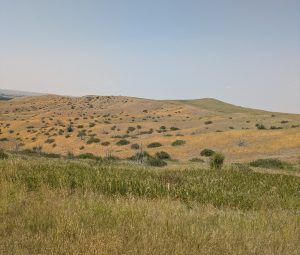
The rolling hills of the Battle of Little Bighorn National Monument. This historic event is also known as the Battle of the Greasy Grass by the Lakota, Cheyenne, Dakota, Arapaho, Crow and Arikara.
I think also that there is a misperception that these sites are isolated and little islands. But they exist as part of a landscape. And, to bridge the gap between archaeology and conservation, it’s always sort of strange to me that we separate archaeology, culture, and landscape—but they can’t really exist without each other. When I protect land, I’m aware I’m trying to protect archaeology on that land. And also protecting and maintaining Indigenous heritage [and culture].
I would like people to bridge that gap between land conservation and historic preservation. I think they go hand in hand. I think people are realizing that a bit more. Bears Ears was a big issue. I received a lot of press [at Archaeology Southwest during the push for Bears Ears to be established as a National Monument]. The Tribes talking about how Bears Ears is where we came from and we have sacred connections to it, [I think helped the general public better understand how to bridge the gap between land conservation and historic preservation.] That perception is changing, but I think it needs to be a greater movement.
Anything else?
I think just the visit to Little Bighorn Battlefield was cool. It was a good way to cap the week in Montana. For me, it was like the perfect monument to visit in this instance. Archaeology played a big role in getting that place protected as a national monument. And also [the Battle of Little Bighorn National Monument] really puts into perspective the sacrifices that were made for America to be America. It was a pretty powerful experience for me to go to that place and learn about history there. When we left and we went to the little gift shop [on the Crow Reservation] where we could see the hills of the battlefield, it just looks like an innocuous ridge from afar. But to realize what went down on them was interesting and also sad.
Want to hear more professional perspectives?
Check out perspectives from:
Bill Kurtz, Bureau of Indian Affairs Midwest Regional Archaeologist
-and-
Anastasia Walhovd, Preservation Archaeologist.
Interested in learning from ARPA Legal Expert Randy Ream too?
Check out the blog posts he has written for SaveHistory.org!
A New Start? Understanding the Latest NAGPRA Regulations
How Often Are Heritage Resource Crimes Prosecuted in Arizona?